Introduction
When we at Reed Consultancy Bangladesh first partnered with Circle Economy, UNIDO, and the Labour at Informal Economy Society for the SWITCH2CE project, we knew we’d be investigating Bangladesh’s textile waste sector. What we didn’t know was that we were about to uncover an entire parallel industry which was massive, thriving, and almost completely invisible.
Our assignment was fairly straightforward. We had to understand the circular textiles value chain in Bangladesh. Map the jhut sector—the informal network handling post-industrial textile waste from our booming garment factories. But as our research team fanned out across twelve districts, from the industrial clusters of Gazipur and Savar to the rural manufacturing hubs of Pabna and Nilphamari, the scale of what we found left us astounded.
What we discovered was staggering: 195,000 to 214,000 workers operating across 18,400 to 22,000 informal facilities in dusty godowns, cramped workshops, and home-based operations. This isn’t a marginal fringe activity—it’s a sophisticated ecosystem processing hundreds of thousands of tons of textile waste annually, turning scraps from the world’s second-largest garment export industry into blankets, ropes, and recycled yarn. These workers have been practicing circular economy principles for decades, long before sustainability became a corporate buzzword. Yet their contributions, their challenges, and even their existence remained largely unknown to policymakers, international buyers, and formal industry stakeholders.
Background
This research was conducted under the SWITCH to Circular Economy Value Chains (SWITCH2CE) project, co-funded by the European Union and the Government of Finland and implemented by UNIDO, with the goal of promoting circular economy practices in global value chains. In Bangladesh’s textile sector, the project brought together a diverse partnership including Circle Economy, UNIDO, Reed Consultancy Bangladesh, Labour at Informal Economy Society, and Bangladesh University of Textiles, combining global expertise with strong local and technical knowledge. It also piloted circular interventions with major brands like H&M Group and BESTSELLER to explore how global supply chains can integrate and support informal waste workers. The study, conducted between February and June 2024 across twelve districts using surveys, focus groups, interviews, and rapid assessments, sought to understand how Bangladesh’s transition to circular textiles can be made just and inclusive—revealing findings that were both encouraging and concerning.
Discovering an Existing Circular Economy
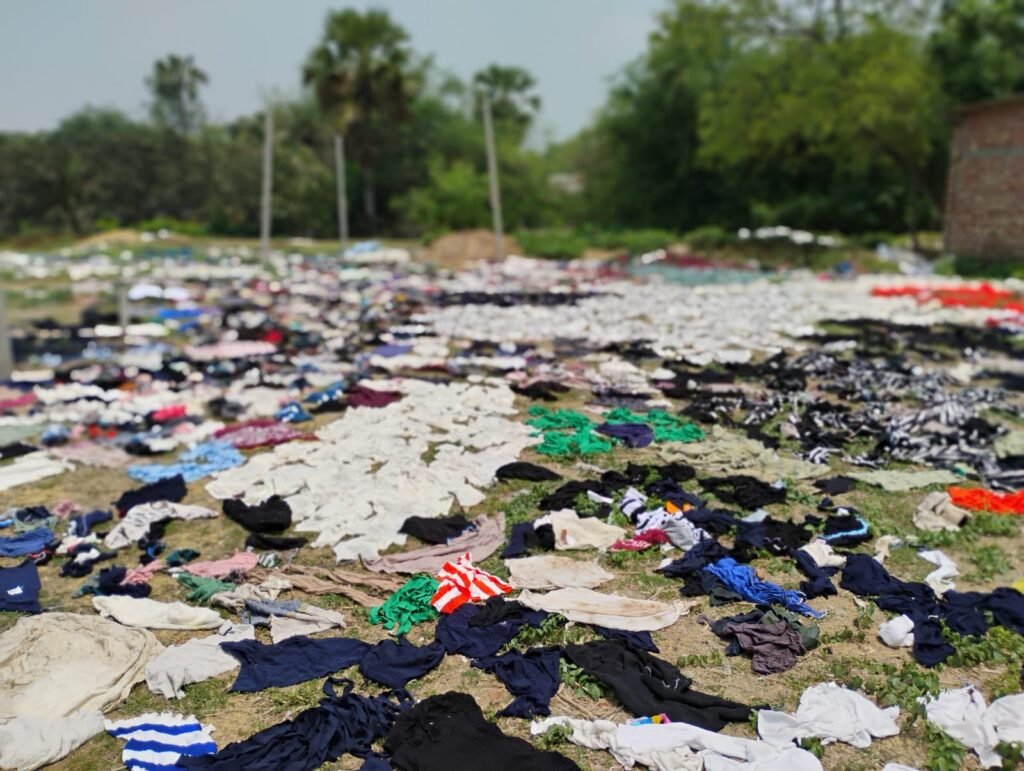
Across Bangladesh’s textile hubs, we observed how jhut—post-industrial textile waste—moves through a complex, informal network.
This is not waste in the conventional sense. It is material in transition.
Through sorting, grading, and redistribution, these materials are:
● Reused in secondary markets
● Recycled into new products
● Redirected into alternative value chains
Without formal systems or recognition, a functioning circular economy is already in place.
And it has been there for years.
What the Data Revealed
Our work, alongside insights from Circle Economy, helped us understand the scale and structure of this ecosystem by mapping material flows, tracing value chains, and identifying the key actors driving the system. What became clear through this process is that circularity in Bangladesh’s textile sector is not an emerging concept, but an existing reality—one that continues to operate largely outside formal visibility.
The Gap We Could Not Ignore
While the jhut sector demonstrates impressive resource efficiency, our research revealed a harsh reality:
● 94% of workers have only verbal agreements, no written contracts
● Average wages of 200-250 taka daily—well below legal minimums
● Zero social security across the informal workforce
● Women earn 75-100% less than men for identical work
● Only 4% belong to any union—virtually no collective bargaining power
● Health hazards: textile dust inhalation, no protective equipment, crowded workspaces, no injury compensation
The gender disparity is particularly stark: women dominate the lowest-paid sorting work while men hold technical roles and better-compensated positions.
Shifting the Lens
This led us to rethink a fundamental assumption that the challenge is not to introduce circularity but to recognize and strengthen it.
Instead of building new systems from the ground up, we need to:
● Understand existing practices
● Integrate informal actors into formal frameworks
● Align economic incentives with social equity
This shift, from creating to recognizing, changes everything.
Towards a Just Circular Transition
Through this work, we began to frame the idea of a just circular transition.
A transition that does not only focus on:
● Reducing waste
● Improving efficiency
● Scaling recycling
But also ensures:
● Inclusion of existing actors
● Fair distribution of value
● Safer and more stable working conditions
Because circularity, without fairness, remains incomplete.
What Comes Next
Hundreds of thousands of workers are already making Bangladesh’s textile industry circular. Their work prevents waste, creates value, and demonstrates what a circular economy can be. We don’t need to create these jobs.- ther already exist. We need to give them decent jobs.
Our commitment is ensuring environmental sustainability and social justice advance together. The jhut workers are showing us the way through recycling, reusing, transforming waste into value. Now we must ensure they receive the recognition, rights, and rewards their contributions deserve.
Bangladesh’s jhut workers are waiting. The question is whether we have the will to see them, hear them, and act.
Conclusion
This work reshaped how we understand the circular economy, that it is not always something we build, but often something we uncover. In Bangladesh’s textile sector, circularity already exists, operating quietly, efficiently, and largely out of sight. Our responsibility now is clear: to make it visible, to make it inclusive, and to make it just.